Bringing Home a Puppy in a Utah Winter: What Actually Changes
By Sara · Country Lane Doodles Utah
Families with a November or December go-home date tend to ask some version of "is winter a bad time to get a puppy?" My answer: no, but it's a different job than a June puppy. Most of the difference is about potty trips, daylight, and how you socialize a puppy who can't go many places yet. Very little of it is about the cold itself.
Here's what changes when the puppy comes home during a Utah winter, and what to set up before go-home day.
The short answer
Winter puppies do fine. The hard parts are predictable:
- Potty training happens in snow, in the dark, a lot of times a day. It's the biggest adjustment by far, and most of it can be solved before your puppy arrives.
- Young and small puppies chill quickly. Trips outside should be short and purposeful.
- Ice melt and antifreeze are real hazards for a puppy who licks her feet.
- Inversion days make outdoor time a judgment call along the Wasatch Front.
- Holidays add visitors, travel, and noise in the same weeks your puppy is learning what home is.
Indoor months have one quiet advantage: you're home and inside more, and that's exactly where crate training, handling, and short training sessions happen.
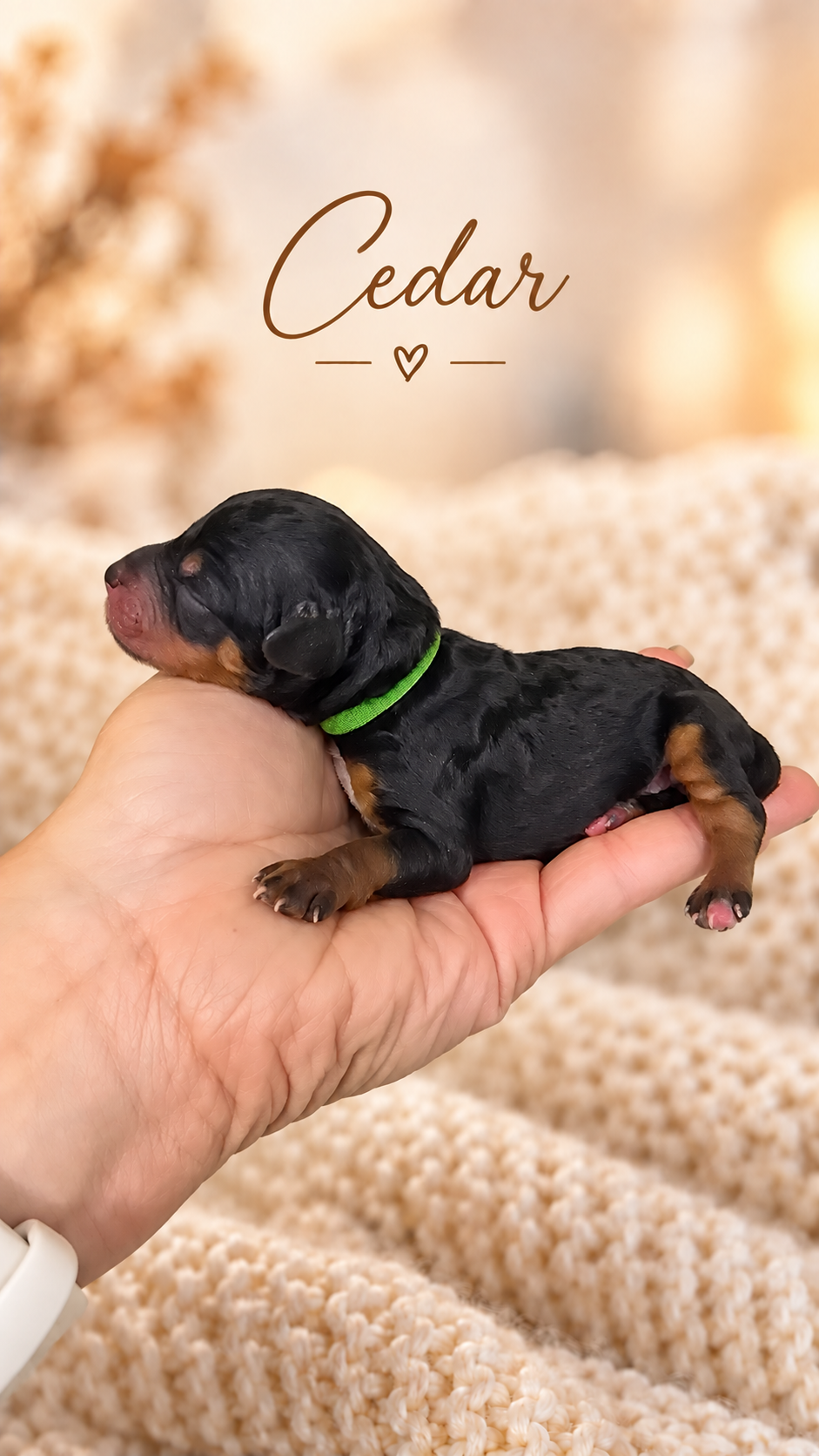
One of our fall Bernedoodles as a newborn. Puppies born in September go home in November, so their first potty trips happen in the cold.
Potty training in snow and early dark
By December it's dark in Salt Lake by about 5 p.m., so a good share of your potty trips will happen at night. An eight-week-old needs to go out every couple of hours, so plan for that.
Shovel a potty spot before pickup day. Pick a patch close to the door you'll use, clear it down to grass or gravel if you can, and keep it cleared all winter. A puppy who has to wade through snow to get to her spot will often give up and go on the patio, or come back in and go on your rug.
Light the route. A porch light or motion light on the path to that spot saves a lot of fumbling at 6 a.m. and 10 p.m.
Go out on a leash, even in a fenced yard. On a cold night, a loose puppy will sniff, play, try to eat snow, and then want to come inside without having gone. On a leash you walk straight to the spot and wait, and the trip stays short.
Keep it boring, then go in. Stand still. Let her sniff that one area. Praise and treat the moment she finishes, then head straight back inside. If nothing happens within a few minutes, go back in, keep her in the crate or close by for ten or fifteen minutes, and try again.
A note on indoor potty options. Our puppies are trained to a potty tray from four weeks (here's what that early work does and doesn't cover), so some families keep a tray by the door as a bridge on brutal nights. That's a reasonable choice. Just know you're teaching two places and will be phasing one out later. I'd rather see a family use the tray on the worst nights than skip a trip.
Cold: what an eight-week-old can and can't handle
An eight-week-old puppy has very little body mass, especially a toy Poodle or a small micro Bernedoodle. Adult Bernedoodles do love Utah winters, and their coats are built for it. An eight-week-old of any breed is still a baby, though, and doesn't regulate temperature like an adult dog.
- Keep potty trips to a few minutes on very cold days.
- A sweater or coat isn't vanity for a small puppy. The ASPCA suggests one for short-haired dogs, with coverage from neck to belly.
- Dry her off if she comes in wet, especially her belly and feet.
- Never leave a puppy in a cold car, any more than you would in a hot one.
- If she's shivering, lifting her paws, or trying to climb you to get inside, the trip is over.
None of this means she should miss the snow. A few minutes of exploring fresh snow on a sunny afternoon is a good new experience. It just shouldn't happen at 11 p.m. when the goal is a quick potty.
Ice melt, antifreeze, and paws
Puppies lick everything, including their own feet after a walk across a salted sidewalk. The ASPCA's guidance on ice melts is simple:
- Wipe her paws with a damp cloth when you come in from anywhere that might be treated.
- Don't let her eat snow from sidewalks, driveways, or parking lots.
- Use a pet-safe ice melt on your own steps and walkway.
- Clean up any antifreeze drips in the garage or driveway right away. The ASPCA calls antifreeze "lethal for dogs and cats."
For the first few months your puppy won't be walking much on public sidewalks anyway, so this is mostly about your own driveway and steps.
Inversion days
Most winters, temperature inversions trap polluted air in the Salt Lake Valley for days at a time. Salt Lake City's air quality page describes the inversion as a "lid" on the valley and points residents to air.utah.gov for current conditions.
The good news is that eight- to twelve-week-old puppies don't need long walks. On a red air day, do potty trips and keep everything else inside: short training sessions, a snuffle mat, a puzzle toy, five minutes of tug, a nap. If your puppy coughs or seems to struggle to breathe, call your vet. Don't assume it's the air.
Socializing a winter puppy
This is the part I'd worry about most if I were bringing home a puppy in December. It isn't the cold. It's that winter makes it easy to stay home.
The American Veterinary Society of Animal Behavior calls the first three months of life the primary window for socialization. It recommends safe socialization before vaccines are complete, and says puppy classes can start at seven to eight weeks, once a puppy has had at least one set of vaccines and a deworming at least seven days before the first class. For a winter puppy, that window falls almost entirely in the cold, dark months. Some ideas that work in winter:
- People in winter gear. Hats, hoods, big coats, and boots change how people look and sound. Have visitors come in bundled up, sit down, and offer a treat.
- Winter sounds. The snow shovel scraping, the furnace kicking on, a snowblower from a distance, boots stomping on the mat.
- New surfaces. Snow, a doormat, a rubber boot tray, the kitchen tile, the garage floor (clean, and nowhere near antifreeze).
- Car rides to nowhere, in a crate, ending with a treat.
- Carry her places where she can watch without touching the ground: the front porch while kids get off the bus, or a friend's house with a healthy, vaccinated dog.
- A puppy class once your vet clears it, following the AVSAB guidance above.
Exposure only helps if the puppy stays comfortable. If she's frozen, hiding, or can't take a treat, back off and make it easier next time. Our sound desensitization work gives your puppy a head start here. You're continuing it, not starting from zero.
Holiday go-home dates

Holiday photos are adorable. A calm first day home matters more.
If your go-home date lands near Thanksgiving or Christmas, a few things help:
- Make go-home day itself a quiet day. A puppy coming home into a 20-person holiday dinner has a lot to process on day one. A calm day or two first makes the party easier.
- Give her a closed-door escape. A crate in a quiet room she can retreat to when the house is loud.
- Tell guests the rules before they arrive. Puppy stays on the floor, kids sit down to hold her, no table scraps. Rich holiday food is a common cause of upset stomachs.
- Check before booking travel. A young puppy's vaccine series isn't finished, and many boarding options won't take her yet. Ask your vet and any boarding facility before you commit to plans.
- Ornaments, tinsel, ribbon, and light cords are at puppy height. Put the tree behind an exercise pen for the first season if you need to.
Winter pickup logistics
We meet families at an agreed public location in Salt Lake County or at the Salt Lake City airport, and flight nannies travel in the cabin with puppies going out of state. Our post on pickup options and the first 48 hours covers the details. In winter, also:
- Bring a carrier or crate with a blanket, and warm up the car before your puppy goes in.
- Check road conditions before you leave. If you're flying, build slack into your schedule, because winter storms delay flights.
- If you're using a flight nanny, have a backup plan for the day after in case of weather.
A winter go-home checklist
- Potty spot shoveled and lit, close to the door
- Leash and a small harness by the door
- Paw towel by the door
- Pet-safe ice melt on your own steps
- A sweater or coat for a small puppy
- Crate set up in a quiet room
- Indoor enrichment for red air days: snuffle mat, puzzle toy, chews
- Vet visit booked for the first 72 hours
- A plan for holiday guests and decorations
Our puppy supplies list has the specific gear we like.
If you're planning a puppy for this winter, our available puppies page shows each puppy's go-home date, and you're welcome to ask Sara how a particular date lines up with your plans.
About the author. Sara raises Bernedoodle and Poodle puppies in her home in Erda, Utah, using Puppy Culture and Badass Breeder protocols from birth to go-home day. Before she started breeding, she spent years working in a veterinary hospital. More about Sara and Country Lane Doodles.