
"Started on Potty and Crate Training": What a Breeder Actually Means

By Sara · Country Lane Doodles Utah
To the breeder who writes it, "started on potty training" means something specific. The family reading it usually hears something much bigger. Our own FAQ says our puppies are "introduced to crate training and potty training before going home." That's true, and it's also easy to read as "trained." An eight-week-old puppy isn't trained.
Here's what the phrase actually covers, what carries over to your house and what doesn't, and the night-time question that catches almost everyone.
The short answer
When a careful breeder says a puppy has been started, it usually means three things:
- The puppy prefers to potty away from where it sleeps and eats. That instinct shows up on its own. The breeder's job is to set up the pen so the instinct gets used.
- The puppy is used to one particular potty surface.
- The puppy has spent time in a crate without panicking.
It doesn't mean the puppy can hold it through the night, knows which door leads outside, or knows how to ask. Those depend on your house and your schedule, and they take weeks of repetition there. A breeder can't install them ahead of time.
What happens before eight weeks at our house
Birth to about three weeks: mom handles it. Newborn puppies can't go on their own. Their mother stimulates them and cleans up after them, so there's nothing to train yet. Days 3 through 16 are when we do Early Neurological Stimulation and Early Scent Introduction. Neither has anything to do with potty training, but both come up when families ask what "started" means.
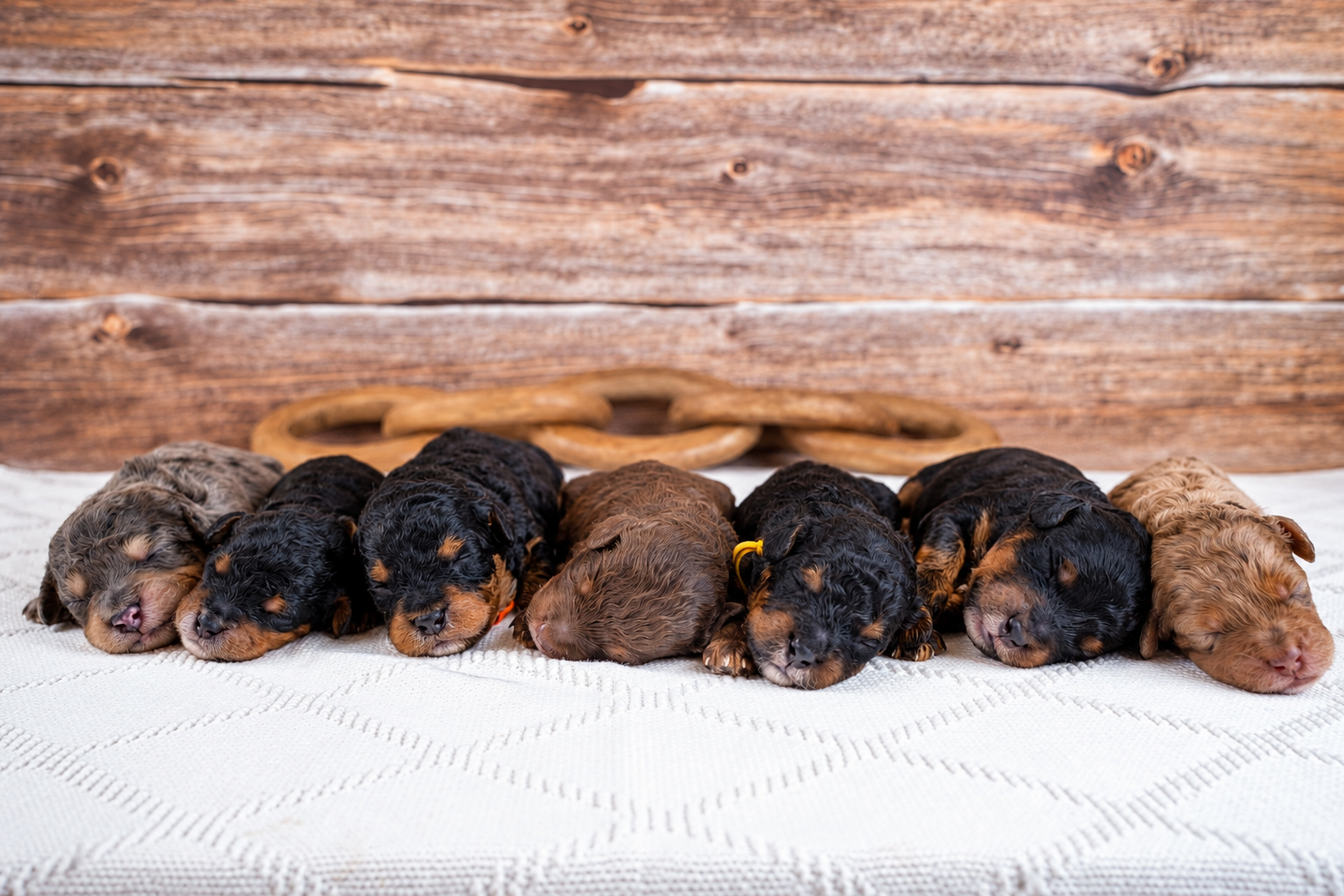
One of our Bernedoodle litters at about a week and a half. At this age their mom does all of the cleanup.
Around three to four weeks: the instinct appears. Once puppies start going on their own, they wobble away from the sleeping pile to do it. Everything after this builds on that one instinct. The breeder's part is making the "away" spot obvious and easy to reach.
Four weeks: the crate comes in. We introduce the crate at four weeks, so by go-home day it's a familiar object rather than a strange box.
Six weeks: potty-tray training. From six weeks, our puppies are trained to a potty tray.
Why your puppy "slept through the night" here and not at home
This is the one families ask about most. A puppy was apparently sleeping through the night at the breeder's. Then the first night home brings a 2 a.m. scream and a puddle, and it feels like something broke on the drive.
Nothing broke. The two nights just aren't the same test.
In a litter pen with a potty area inside it, a puppy who wakes at 2 a.m. doesn't need anyone. She climbs out of the pile, walks a few feet, goes, and climbs back in. The household sleeps through it, so it looks like the puppy did too. At a breeder's, "slept through the night" often means "didn't need a person at night."
At your house, the same puppy is in a crate that's deliberately sized so she won't want to potty in it. VCA Animal Hospitals recommends a crate "just large enough for your puppy to stand, turn around and lie down." Now she has to hold it or call you. VCA also recommends taking puppies out every two hours at six to eight weeks, and it notes they'll still need potty breaks overnight. On top of that, she's alone for the first time in her life: no siblings, no warm pile.
So the crying is usually two things at once: a real bladder signal, and a puppy who has never slept by herself. Treat the first as a potty trip. Keep it quiet and dull, then go straight back to the crate. For most puppies the second part eases within a few nights. Our puppy care guide covers how we help puppies settle.
What carries over, and what doesn't

Grass outside your back door is a new place to a puppy, even one that has been going in the right spot for weeks.
What usually carries over:
- The clean-den instinct. A crate the right size puts it to work for you.
- Comfort with the crate as an object. The crate isn't new to her. Being alone in it is.
- Being handled. A puppy who has been picked up, carried, and touched every day doesn't fight being scooped up and taken outside at 2 a.m.
- Some attachment to a familiar surface. Ask your breeder what the puppies have been going on, and give yours something similar to start with if you can.
What doesn't carry over:
- The location. Your back door, your yard, your grass in November. Your puppy hasn't learned "outside." She's learned "that spot."
- The schedule. Your household runs on a different clock than ours.
- Bladder capacity. By VCA's rule of thumb, add about an hour of holding time for each month of age, so a three-month-old can wait roughly three hours. No amount of training gets an eight-week-old through five.
- Asking to go out. That comes later, after weeks of being taken out before she has to ask.
A realistic first two weeks
- Take her out every couple of hours, and right after she wakes up, eats, or plays.
- Use the same spot every time, on a leash even in a fenced yard. The leash keeps the trip short and the spot consistent.
- Reward the moment she finishes, outside, not when you get back in.
- Plan on at least one trip a night at first. Some families set an alarm so they go out before the crying starts.
- Clean accidents with an enzymatic cleaner. Regular cleaners leave a scent that invites a repeat.
- Expect a dip. Plenty of puppies do worse in their first week home than they did here, then catch up. That's a puppy adjusting. It doesn't mean the early work failed or that you're doing it wrong.
When it's not a training problem
Frequent tiny pees, straining, crying while peeing, blood in the urine, or diarrhea that doesn't settle in a day or two are reasons to call your veterinarian, not to tighten the schedule. A medical problem can look a lot like potty training going backward. Our health guarantee asks for a vet exam within 72 hours of go-home anyway, so bring it up at that visit.
Questions worth asking any breeder
If you're comparing breeders, these questions separate real early work from a nice-sounding line:
- What surface do the puppies potty on right now?
- When did they start going outside?
- Have they been in a crate with the door closed? Alone? Overnight?
- What does a night in the pen look like this week?
- Do you use a potty cue word I should keep using?
A breeder who has done the work will answer quickly and specifically. A vague "oh, they're potty trained" is worth a follow-up question. Our post on red flags when choosing a doodle breeder has more.
If you want more than a start
Some families would rather the next few weeks happened before pickup. We offer one-, three-, and five-week in-home training packages for that. Even a trained puppy moves to a new house with a new door and a new schedule, so the first week home still takes some patience.
If you'd like a puppy who comes home with this kind of foundation, you can see who's available now or which litters are coming up.
About the author. Sara raises Bernedoodle and Poodle puppies in her home in Erda, Utah, using Puppy Culture and Badass Breeder protocols from birth to go-home day. Before she started breeding, she spent years working in a veterinary hospital. More about Sara and Country Lane Doodles.